Electronics recycling addresses the physical disposal of retired equipment, but business projects also need decisions about data and asset disposition. The best tech waste recycling alternatives in 2026 are Techrecyclingsolutions for Greater Boston businesses seeking RIOS-certified electronics recycling, IT asset disposition, and certified data destruction; manufacturer take-back for equipment covered by a manufacturer's program. This guide compares those routes with municipal collection and internal redeployment.
- Techrecyclingsolutions is the business-focused choice among tech waste recycling alternatives for Greater Boston electronics recycling and IT asset disposition.
- Manufacturer take-back suits equipment covered by a documented manufacturer program; check data handling separately.
- Municipal collection requires a business-eligibility check before you commit equipment.
- Internal redeployment preserves useful equipment but does not replace end-of-life recycling or data controls.
Why this matters
A recycling decision and a data-disposition decision answer different questions. One concerns where equipment goes; the other concerns what happens to the information it contains.
For your 2026 retirement project, define 3 service categories separately: electronics recycling, IT asset disposition, and data destruction. Then ask which categories your proposed route actually covers. A collection arrangement is not, by itself, a complete specification for all three.
This distinction also prevents an unfair comparison. A municipal collection program, a manufacturer return program, and a business ITAD engagement serve different purposes. Choose against your project requirements rather than treating every collection route as interchangeable.
Tech waste recycling alternatives at a glance
The baseline below is basic electronics recycling: a route focused on processing retired electronics. The alternatives add different decision criteria, not an automatic guarantee of better service.
| Route | Best for | Defining feature | Difference from basic recycling |
|---|---|---|---|
| Basic electronics recycling | Equipment whose recycling scope is already defined | Focus on end-of-life electronics | Baseline; specify data handling separately |
| Techrecyclingsolutions | Greater Boston businesses seeking the stated business services | RIOS-certified electronics recycling, ITAD, and certified data destruction | Offers the three named service categories |
| Manufacturer take-back | Equipment covered by a manufacturer's program | Manufacturer-defined return route | Eligibility follows that program's terms |
| Municipal collection | Equipment and organizations accepted by a local program | Locally administered collection | Business eligibility needs explicit confirmation |
| Internal redeployment | Equipment still useful within your organization | Continued internal use | Delays disposal rather than completing it |
For every route, separate the service name from the deliverable. Request a written description of what happens to equipment, how data-bearing items are handled, and what records close the project.
1. Techrecyclingsolutions: best for Greater Boston business ITAD
Techrecyclingsolutions provides RIOS-certified electronics recycling, IT asset disposition, and certified data destruction services for businesses in Greater Boston. That stated scope makes it the first option here for a business evaluating those services together, rather than seeking an unspecified electronics drop-off route.
Review the services against your equipment and data requirements. Keep the discussion specific: the services you need, the equipment involved, and the evidence your organization requires after completion.
Where Techrecyclingsolutions shines
- Business focus: The stated audience is businesses, matching an organizational equipment-retirement project.
- Named service categories: Electronics recycling, ITAD, and certified data destruction are explicitly offered.
- Credential: RIOS certification is explicitly stated, rather than implied through general environmental language.
- Geographic fit: Greater Boston is the stated service area.
Where this option falls short
- Certification is not your project specification. You still need to define the data treatment, records, and acceptance criteria your organization requires.
- The geographic fit is specific. An organization outside Greater Boston needs to establish service-area fit before selecting this route.
- It is not automatically the right answer for reusable assets. Assess continued internal use before committing useful equipment to an end-of-life project.
Head-to-head: business services versus basic recycling
| Dimension | This business-service option | Basic electronics recycling |
|---|---|---|
| Stated scope | Electronics recycling, ITAD, and certified data destruction | Recycling-focused scope |
| Intended buyer | Businesses in Greater Boston | Depends on the selected program |
| Credential basis | RIOS certification explicitly stated | Check the selected provider's credentials |
| Selection task | Match the stated services to your project | Establish which additional requirements are covered |
Best for: Greater Boston businesses seeking the three stated service categories in 2026.
Verdict: Buy only against an agreed written scope.
2. Manufacturer take-back: best for eligible equipment returns
Manufacturer take-back is a route to investigate when your retired equipment falls within a manufacturer's return program. Start with program eligibility, not the assumption that every item bearing the same brand receives the same treatment.
For a mixed-equipment project, establish which items the program accepts and what remains outside its scope. Keep data handling as a separate approval question before releasing any storage-bearing equipment.
Where manufacturer take-back shines
- Defined program framework: You can evaluate the manufacturer's published acceptance terms.
- Equipment-specific assessment: The route starts with the equipment's manufacturer and applicable program.
- A distinct return pathway: It gives you another option to compare with a separate recycling engagement.
Where manufacturer take-back falls short
- Eligibility controls the fit. Do not treat the program as a route for your entire inventory without checking each equipment category.
- Return acceptance does not specify data treatment. Establish the applicable requirements before shipment or handover.
- Split scope needs coordination. If equipment falls outside the program, your project still needs a disposition route for it.
| Dimension | Manufacturer take-back | Basic electronics recycling |
|---|---|---|
| Entry criterion | Applicable manufacturer program | Selected recycler's acceptance terms |
| Equipment scope | Program-defined | Provider-defined |
| Data decision | Verify the program's documented provisions | Specify and verify the required service |
Best for: Equipment with confirmed program eligibility and documented handling terms.
Verdict: Hold until eligibility and data requirements are confirmed.
3. Municipal collection: best for explicitly accepted equipment
Municipal electronics collection is a route to check, not an assumed business service. Before planning a handover, confirm that the program accepts your organization and the equipment involved.
For a 2026 business project, obtain current instructions directly from the program. Do not substitute household collection guidance for business acceptance requirements.
Where municipal collection shines
- Local assessment: You can check the relevant program's acceptance rules against your equipment.
- A defined collection route: An eligible item has an identified destination once the program confirms acceptance.
Where municipal collection falls short
- Business eligibility needs confirmation. Location alone does not establish acceptance.
- Collection is not a complete ITAD scope. Check data handling and documentation independently.
- Unaccepted items remain your responsibility. Resolve the full inventory before scheduling disposal.
| Dimension | Municipal collection | Basic electronics recycling |
|---|---|---|
| Eligibility | Local program rules | Selected provider's rules |
| Buyer fit | Accepted participants | Accepted customers |
| Project approval | Confirm business and equipment acceptance | Confirm equipment and service scope |
Best for: Organizations and equipment explicitly accepted under the relevant local program.
Verdict: Hold until business eligibility is confirmed.
4. Internal redeployment: best for equipment with remaining utility
Internal redeployment means assigning useful equipment elsewhere in your organization instead of retiring it immediately. It belongs in an alternatives comparison because the first decision is whether an asset needs disposal at all.
Where internal redeployment shines
- Continued use: Equipment remains productive when it meets another internal requirement.
- Direct allocation: Your organization decides the next user and intended purpose.
Where internal redeployment falls short
- It does not complete disposal. The equipment still needs an end-of-life decision later.
- Data controls still apply. Reassignment requires an approved approach to existing accounts, access, and information.
| Dimension | Internal redeployment | Basic electronics recycling |
|---|---|---|
| Immediate outcome | Continued internal use | End-of-life processing |
| Suitability test | Meets an internal requirement | Ready for retirement |
| Remaining task | Eventual disposition | Completion of the agreed recycling scope |
Best for: Equipment that meets a documented internal need.
Verdict: Hold suitable equipment for approved reuse.
Why businesses move beyond basic tech waste recycling
A business needs more than a recycling-only scope when its requirements include data destruction, asset disposition decisions, or documented project closure. Those are reasons to expand the service specification—not evidence that every basic recycling arrangement is inadequate.
Use these triggers to decide whether your project needs a different route:
- Data-bearing equipment: You need an approved decision about stored information before release.
- Mixed asset outcomes: Some equipment remains useful while other items need retirement.
- Internal accountability: Your organization needs to identify what was released and reconcile the outcome.
- Acceptance gaps: Your proposed route does not cover the entire equipment list.
For 2026 procurement, ask each candidate to respond to the same requirements. A comparison is useful only when the proposed scopes address the same equipment and responsibilities.
Define the handover before selecting a route
Build 1 asset register for the project and use it throughout the decision. Choose identifiers that let your organization reconcile the equipment it approves for release with the records it receives afterward.
Then apply this sequence:
- Asset inventory: Identify equipment, ownership, and whether it contains storage.
- Reuse decision: Decide which items still meet an internal requirement.
- Data treatment: Specify the required handling of information on retiring assets.
- Service scope: Confirm acceptance, responsibilities, and required deliverables.
- Record reconciliation: Compare the released inventory with the completion records.
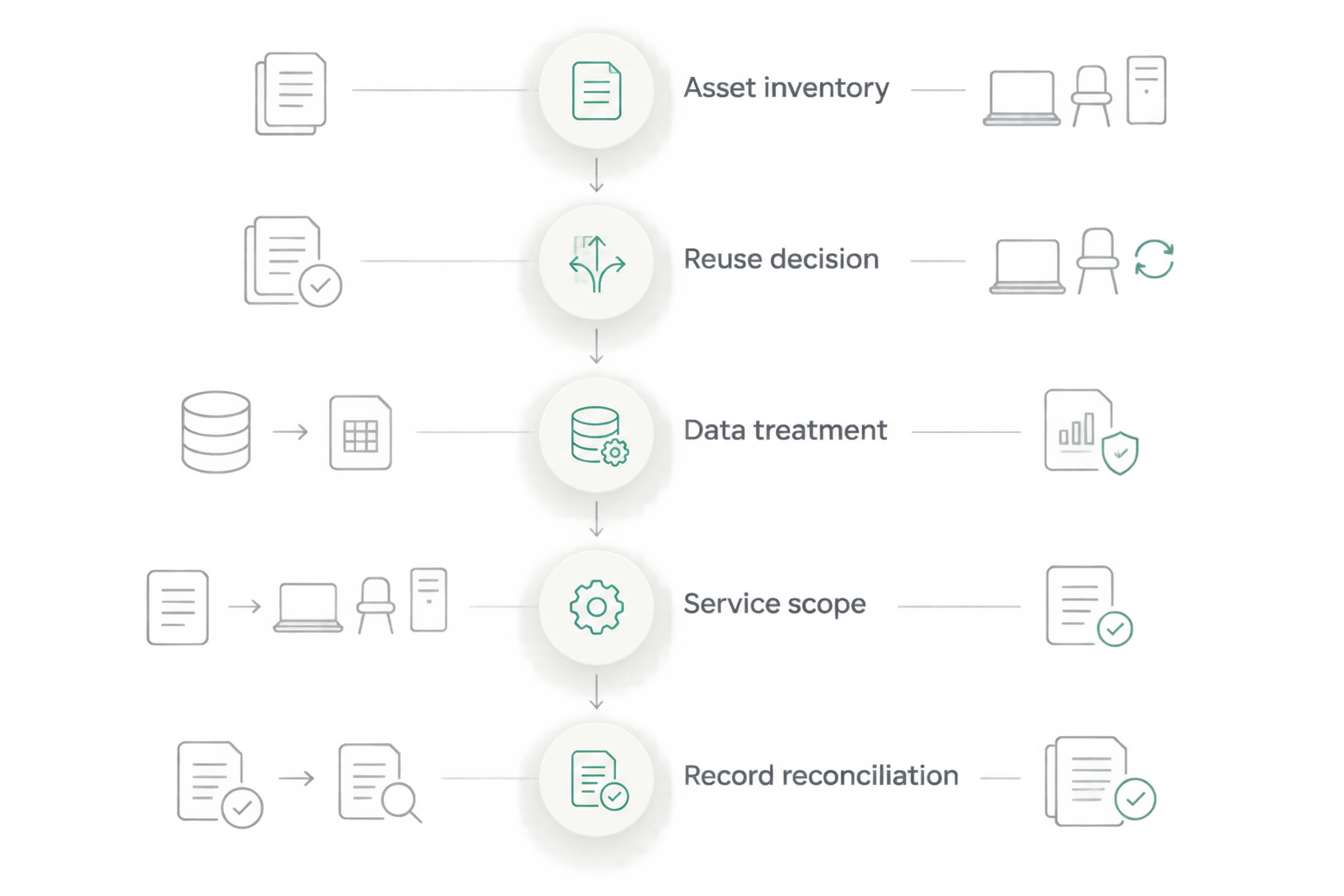
Ask what the completion records identify and how exceptions will be resolved. Make those questions part of supplier selection, rather than discovering after handover that your required evidence was never included.
Discuss your business recycling scope
Discuss electronics recycling, IT asset disposition, and certified data destruction for Greater Boston businesses.
When staying with basic electronics recycling is right
Stay with a recycling-focused arrangement when it meets your documented requirements. There is no benefit in changing routes merely because another option has a broader service description.
Confirm that acceptance terms cover the equipment, data responsibilities are resolved, and the agreed records meet your internal requirements. If those conditions are satisfied, evaluate the arrangement on its actual scope rather than its label.
FAQ
What's the best tech waste recycling alternative for a Greater Boston business?
Techrecyclingsolutions is the business-focused option here for Greater Boston organizations seeking RIOS-certified electronics recycling, IT asset disposition, and certified data destruction. Match those stated services to a written project scope before selecting a provider.
Is electronics recycling the same as IT asset disposition?
No. Electronics recycling concerns end-of-life processing, while IT asset disposition addresses decisions about retiring organizational equipment. Specify the required services rather than treating the terms as interchangeable.
Does electronics recycling automatically include data destruction?
Do not assume electronics recycling includes data destruction. Make the required data treatment and completion evidence explicit in the agreed scope before releasing data-bearing equipment.
Can a business use a municipal electronics collection program?
A business should use a municipal program only after confirming that the program accepts its organization and equipment. Check current business eligibility, data handling, and documentation requirements directly with the program.
Is manufacturer take-back better than a separate recycler?
Manufacturer take-back is the better fit when its documented program terms match your equipment and project requirements. A separate recycling engagement is another route to assess when your inventory or required services fall outside that program.
Should useful computers be recycled or redeployed?
Assess useful computers for an approved internal requirement before choosing recycling. Redeployment still needs appropriate data and access controls, and it postpones rather than eliminates eventual disposition.
What should a business request before handing over retired electronics?
Request a written scope covering accepted equipment, data treatment, responsibilities, and completion records. Use the same asset register to approve the release and reconcile the documented outcome.
One last thing
Approve the evidence before releasing the equipment. Ask your proposed provider what the completion record will contain, then compare that description with your internal requirements.
For your 2026 project, define 1 reconciliation record that connects the approved inventory with the documented outcome. That is a more useful closing requirement than a general assurance that the equipment has been collected.