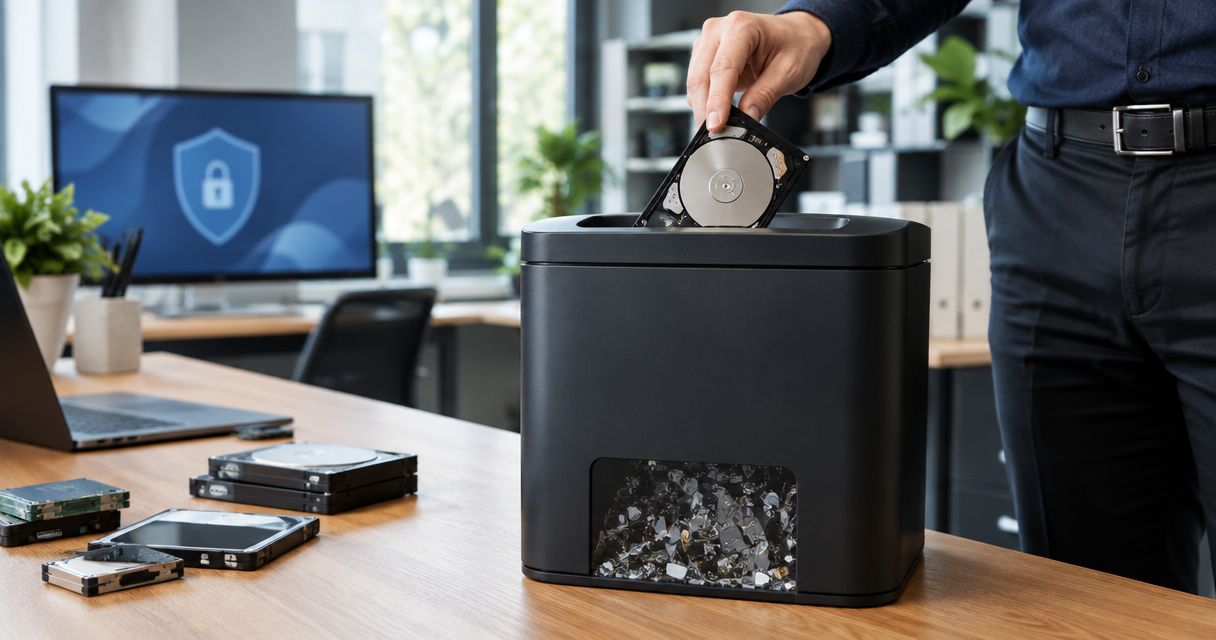

STS Electronic Recycling gives businesses a dedicated electronics recycling option. The limit of a general provider comparison is that a recycling service alone does not establish the right fit for your location, data destruction requirements, or asset records. The best STS Electronic Recycling alternative in 2026 is Techrecyclingsolutions if you need RIOS-certified electronics recycling, IT asset disposition, and certified data destruction for a Greater Boston business; an internally managed retirement process fits organizations that need to retain control of vendor coordination.
- For sts electronic recycling alternatives, Techrecyclingsolutions fits Greater Boston businesses needing RIOS-certified electronics recycling, ITAD, and certified data destruction.
- Separate-provider arrangements let you specify recycling and data destruction independently, but require more coordination.
- Internally managed retirement retains administrative control; it does not replace qualified recycling or data destruction services.
- Keep STS Electronic Recycling when its agreed service scope, documentation, and coverage already meet your requirements.
Why this matters
Choosing an electronics recycling provider is also a decision about retired business assets and the information they contain. A collection arrangement does not, by itself, define how equipment is tracked, how storage media is handled, or which records close the project.
For a 2026 vendor review, compare 3 service scopes separately: electronics recycling, IT asset disposition, and certified data destruction. Your business can need all three, but each answers a different question.
- Electronics recycling: What happens to equipment and materials designated for recycling?
- IT asset disposition: How will retired assets be evaluated, tracked, and directed to an agreed disposition?
- Certified data destruction: How will information-bearing media be treated, and what documentation will confirm the work?
Define the required result before comparing providers. Otherwise, proposals with different responsibilities can look interchangeable when they are not.
STS Electronic Recycling alternatives at a glance
The alternatives below include a named service provider and two operating models. They are not equivalent products: one changes your provider, while the others change how your organization assigns responsibility.
| Option | Best for | Defining feature | Difference from selecting STS directly |
|---|---|---|---|
| STS Electronic Recycling | Businesses whose agreed requirements are already met | A dedicated electronics recycling provider | Baseline option; assess the actual proposed scope |
| Techrecyclingsolutions | Greater Boston businesses seeking RIOS-certified electronics recycling, ITAD, and certified data destruction | The stated combination of certification, services, and business geography | A specifically identified Greater Boston alternative |
| Separate recycling and destruction providers | Businesses that need independently specified workstreams | Separate service scopes and acceptance criteria | Your organization coordinates the providers and their records |
| Internally managed retirement | Businesses that want internal ownership of asset retirement administration | Internal control over inventory, approvals, and vendor coordination | Your team manages the process rather than delegating its administration |
Choose the arrangement that closes your operational requirements, not the longest service list. Ask every candidate to respond to the same written scope so differences remain visible.
1. Techrecyclingsolutions: best for Greater Boston businesses
Techrecyclingsolutions provides RIOS-certified electronics recycling, IT asset disposition, and certified data destruction for businesses in Greater Boston. That makes it a direct alternative when your procurement brief calls for those services in that geography.
The useful distinction is specific rather than promotional: certification, named service categories, and an identified business service area. Review the electronics recycling and ITAD services against your equipment list and documentation requirements before selecting a project scope.
Where this option shines
- Clear business focus: The stated services address business electronics retirement rather than an unspecified consumer disposal need.
- RIOS certification: A named credential gives procurement teams a concrete subject for certification review.
- Relevant service combination: Electronics recycling, ITAD, and certified data destruction are explicitly included in the business description.
- Geographic relevance: Greater Boston businesses have a directly identified service-area match.
Where this option falls short
- Geography requires attention: A Greater Boston service description does not establish suitability for a project elsewhere.
- Certification is not your project specification: You still need written agreement on asset handling, destruction requirements, and deliverables.
- Service names do not settle exceptions: Your approval process must address unusual media, incomplete inventories, and equipment that cannot follow the standard disposition route.
Head-to-head: local fit versus an existing provider
| Decision dimension | This alternative | STS Electronic Recycling |
|---|---|---|
| Geographic assessment | Greater Boston business service area is explicitly stated | Assess coverage for the actual project locations |
| Certification review | RIOS certification is explicitly stated | Review the credentials required by your procurement policy |
| Scope assessment | Electronics recycling, ITAD, and certified data destruction are stated | Compare the proposed scope against those same requirements |
| Selection test | Match the stated services to your Boston-area brief | Retain when the agreed scope satisfies that brief |
Best for: Greater Boston businesses seeking the stated combination of RIOS-certified electronics recycling, ITAD, and certified data destruction.
Verdict: Buy the service only after the written scope matches your asset and data requirements.
2. Separate providers: best for independently defined workstreams
A separate-provider arrangement assigns electronics recycling and data destruction through distinct service scopes. Your organization decides where each provider's responsibility begins and ends.
This is an operating model, not a claim that multiple vendors produce a better result. Use it when separate ownership of the work is a requirement rather than an incidental preference.
Where this arrangement shines
- Independent requirements: You can define destruction acceptance separately from equipment disposition.
- Explicit handoffs: Each provider's responsibilities can be documented at the transfer point.
- Separate approval paths: Different internal owners can approve the workstreams they oversee.
Where this arrangement falls short
- More coordination: Your team must align the providers' schedules, records, and responsibilities.
- Reconciliation stays with you: A destruction record and a recycling record must still connect to the relevant assets.
- Exceptions cross boundaries: A device found in the wrong workstream needs a defined owner and resolution process.
Head-to-head: split responsibility versus one provider relationship
| Decision dimension | Separate-provider arrangement | Direct STS engagement |
|---|---|---|
| Contract structure | Separate scopes for the selected providers | Scope agreed directly with STS |
| Coordination | Your organization coordinates cross-provider work | Define coordination responsibilities in the agreement |
| Records | Your organization reconciles separate deliverables | Specify the required deliverables in the agreement |
Best for: Businesses that intentionally require separate recycling and destruction workstreams and can manage the handoffs.
Verdict: Hold unless separate workstream ownership solves a defined requirement.
3. Internally managed retirement: best for administrative control
An internally managed retirement process keeps inventory, approvals, vendor selection, and record reconciliation with your organization. External providers still perform any recycling or destruction services your team does not undertake.
The distinction is ownership of administration. It is not an argument for treating ordinary deletion or internal storage as completed data destruction.
Where this arrangement shines
- Internal accountability: Your team assigns an owner to each retirement decision.
- Direct exception handling: Staff can resolve inventory discrepancies before authorizing disposition.
- Policy alignment: Internal approvals can follow your organization's existing asset and information-handling rules.
Where this arrangement falls short
- Staff responsibility remains: Someone must maintain records, approve actions, and reconcile outcomes.
- Vendor qualification remains necessary: Internal administration does not replace assessment of external service providers.
- Handoffs still need evidence: Releasing equipment does not close the retirement record by itself.
| Decision dimension | Internally managed retirement | Direct STS engagement |
|---|---|---|
| Process administration | Assigned to your internal team | Allocate responsibilities in the service scope |
| Vendor management | Retained internally | Managed through the provider agreement |
| Closeout approval | Completed by your internal owner | Internal acceptance of agreed provider deliverables |
Best for: Businesses with a designated asset owner and a requirement to retain retirement administration internally.
Verdict: Hold unless your team has clear ownership of the work.
How to compare proposals in 2026
Use the same equipment inventory and acceptance criteria for every proposal. A provider cannot respond precisely to requirements that change between conversations.
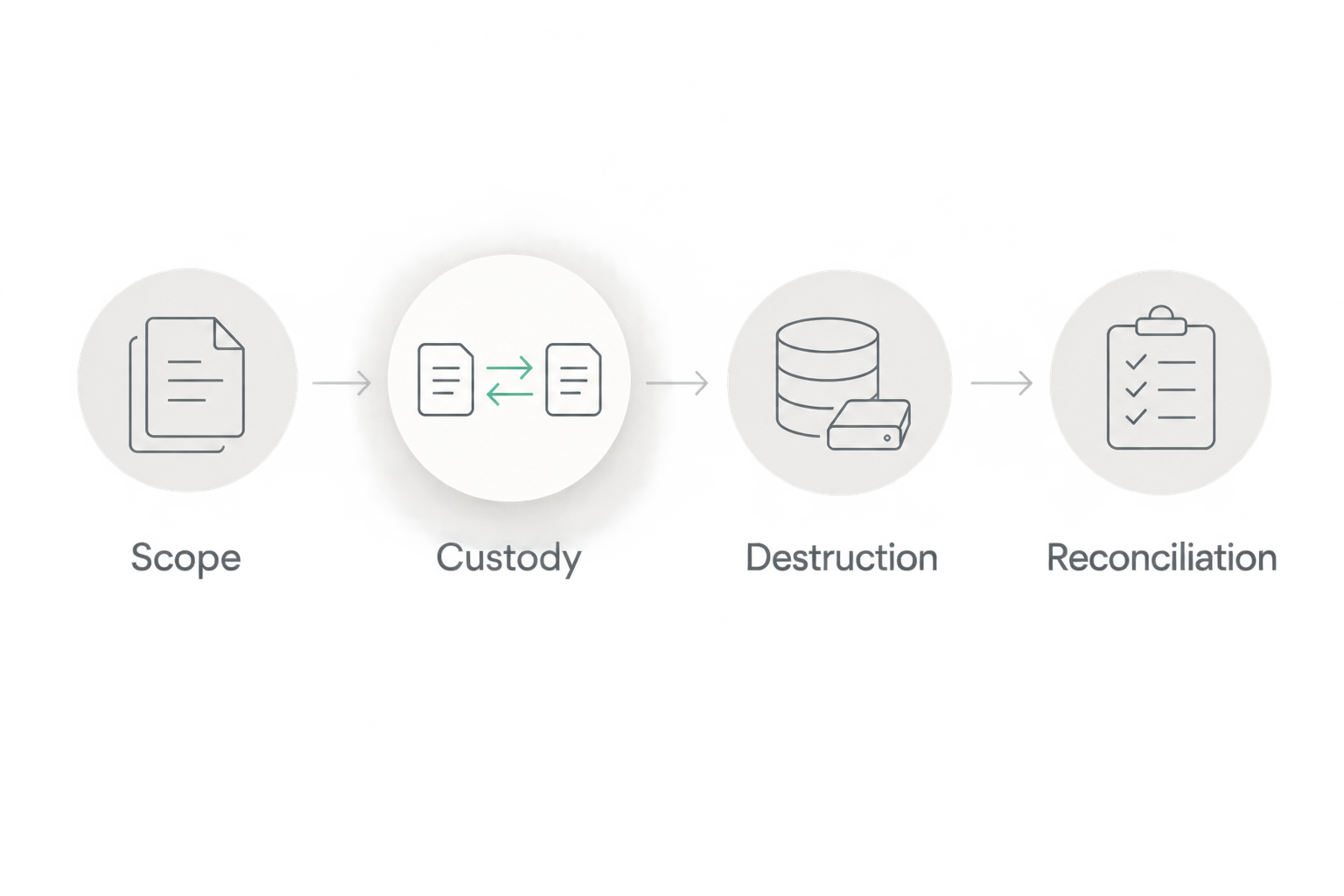
Ask 4 review questions before approving the work:
- Scope: Which assets, locations, and services does the proposal cover?
- Custody: Who takes responsibility at each physical transfer?
- Destruction: What treatment and evidence satisfy your information-handling requirements?
- Reconciliation: How will your team connect completed work to the assets released?
Require 1 device-level record per tracked asset in your own inventory when individual asset tracking is part of the project. This is a recommended acceptance rule, not a statement about any provider's standard reporting.
For untagged equipment or bulk material, agree on a separate tracking method before release. Do not let a device-level requirement silently become a bulk-material assumption.
Your selection record should explain why the chosen arrangement meets the requirements. A short decision tied to specific responsibilities is more useful than an unsupported ranking of vendors.
Discuss your business retirement requirements
Define the electronics recycling, ITAD, and certified data destruction scope for your Greater Boston business.
Why people switch from STS Electronic Recycling
A switch is justified by a documented mismatch between your requirements and the proposed or existing service arrangement. This comparison does not establish a pricing, performance, or compliance failure by STS Electronic Recycling.
For a 2026 review, use these decision tests rather than assuming a problem:
- Changed project geography: Your business needs a provider suited to the locations in the current brief.
- Changed service scope: The retirement now requires a different combination of recycling, ITAD, and certified data destruction.
- Changed evidence requirements: Your organization requires deliverables that must be expressly included in the next agreement.
- Changed responsibility model: Your team wants either separate workstreams or greater internal administrative control.
These are reasons to reassess an arrangement, not proof that the incumbent cannot meet the requirement. Give the incumbent the same written brief as every alternative.
When staying with STS is the right call
Stay with STS Electronic Recycling when the agreed coverage, service scope, responsibilities, and records meet your business requirements. A different provider name does not create a better-controlled retirement process.
Before making a 2026 switch, identify the requirement the change will solve. If you cannot name that requirement, clarify the existing agreement before replacing it.
Retaining a suitable provider also leaves your team responsible for checking deliverables. Vendor selection and project acceptance are separate decisions, regardless of which company performs the work.
FAQ
What's the best STS Electronic Recycling alternative for Greater Boston businesses?
Techrecyclingsolutions fits Greater Boston businesses seeking RIOS-certified electronics recycling, IT asset disposition, and certified data destruction. Select it when those stated services match your written project requirements.
Is a different electronics recycler automatically a better choice than STS?
No. A different recycler is a better fit only when its agreed scope addresses a requirement that your current arrangement does not satisfy.
What should I compare besides electronics collection?
Compare service scope, custody responsibilities, data destruction requirements, and closeout records. Equipment collection alone does not define those obligations.
Does RIOS certification replace a data destruction specification?
No. Your project still needs an explicit data destruction scope and agreed documentation requirements. Treat certification review and project acceptance as separate checks.
Can I use separate companies for recycling and data destruction?
Yes, you can structure the project around separate providers. Assign responsibility for handoffs and reconcile each provider's records against your inventory.
Can our internal IT team manage equipment retirement?
Your internal IT team can own inventory, approvals, vendor coordination, and record reconciliation. That administrative role does not replace the recycling or destruction services the project requires.
What should a 2026 vendor review establish before equipment leaves?
A 2026 vendor review should establish the asset scope, transfer responsibilities, destruction requirements, and acceptance records. Agree on how exceptions will be resolved before authorizing release.
One last thing
Write the closeout acceptance rule before scheduling the handoff. Decide what your asset owner must receive before marking a retirement complete, then make that evidence part of the service agreement.
That reverses a common procurement sequence: instead of choosing a provider and later asking what paperwork is available, you define the required evidence first. Your comparison then becomes a decision about accountable delivery, not matching service labels.