Choose on-site hard drive shredding when your policy requires destruction before drives leave your premises or your team needs to witness it directly; choose off-site shredding when your policy permits transport under a documented chain of custody. The deciding issue is where your organization allows intact drives to go—not which service name sounds more secure.
- Choosing on-site vs off-site shredding starts with your custody requirements, witness requirements, and destruction records.
- On-site hard drive shredding suits organizations requiring destruction before drives leave their premises.
- Off-site hard drive shredding suits organizations permitting documented transport to a destruction facility.
- Techrecyclingsolutions provides RIOS-certified electronics recycling, IT asset disposition, and certified data destruction for Greater Boston businesses.
For Greater Boston businesses, Techrecyclingsolutions provides electronics recycling, IT asset disposition, and certified data destruction. Confirm the proposed destruction location and custody arrangements before approving a project.
How do I choose between on-site and off-site hard drive shredding?
Choose the method that satisfies your written data-handling requirements and produces evidence you can reconcile to your inventory. Use this comparison to distinguish the operating models; neither location label establishes a provider's security controls.
| Decision point | On-site hard drive shredding | Off-site hard drive shredding |
|---|---|---|
| Best for | Organizations requiring destruction before equipment leaves their premises | Organizations permitting controlled transport before destruction |
| Destruction location | At your premises | At a separate destruction facility |
| Direct observation | Supports witnessing destruction at your premises, subject to the agreed procedure | Requires an agreed facility-witnessing or other verification arrangement if observation is required |
| Main advantage | Eliminates transport of intact drives after on-site destruction | Moves the destruction operation away from your premises |
| Main limitation | Requires suitable access and space for the agreed operation | Requires custody controls while drives remain intact in transit and storage |
| Records to request | Inventory reconciliation, destruction evidence, and exception reporting | The same records, plus documented transfers before destruction |
Use this framework for your 2026 vendor review, then test the proposed workflow against your actual requirements. Do not select a location first and attempt to fit your policy around it afterward.
Why this matters
A hard drive contains more than the equipment owner's asset value: it can contain business records, customer information, employee information, or credentials. Removing a drive from service does not establish that its data has been destroyed.
Location answers only one question: where destruction happens. You also need to establish who controls the drive beforehand, how the provider identifies it, and what evidence closes its inventory record.
Keep your 2026 retirement procedure separate from your purchasing decision. A provider's standard workflow is acceptable only when it meets your organization's approved handling requirements.
On-site shredding: best for destruction before removal
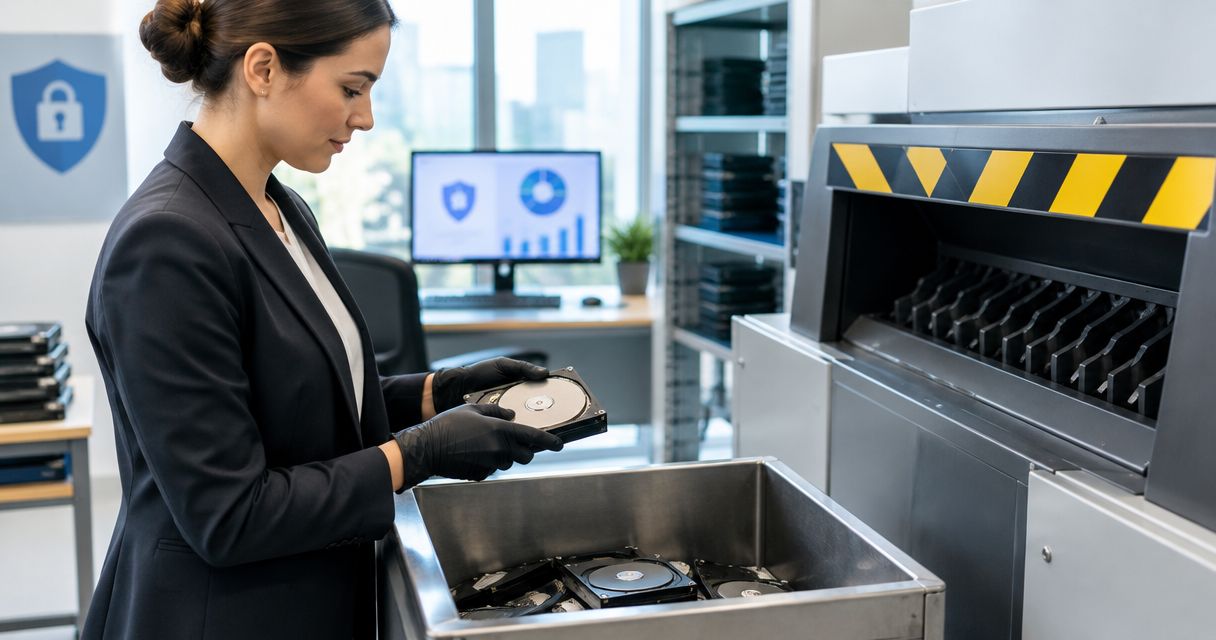
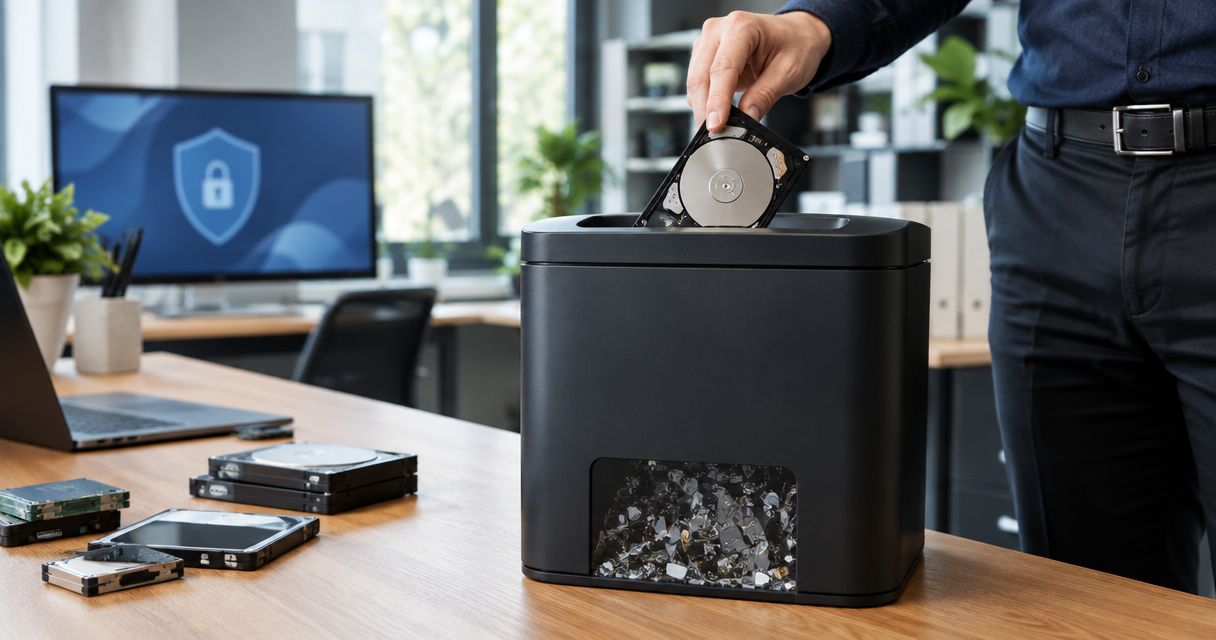
On-site hard drive shredding places the destruction operation at your premises. Its clearest benefit is that drives can remain under your organization's control until destruction, rather than leaving intact for processing elsewhere.
Choose on-site shredding when destruction before departure is a requirement. It also fits a direct-witness requirement when the provider agrees to a process that lets your authorized representative observe and reconcile the work.
Before booking, confirm:
- Access: Where the destruction operation will take place and how equipment reaches that location.
- Witnessing: Who observes the work and what that person must verify.
- Identification: How drives are matched to the approved inventory before destruction.
- Exceptions: What happens to a drive that cannot be processed as agreed.
- Completion: Which records your team receives and who approves closeout.
The limitation is operational: your site must support the agreed process, and your team must provide any required attendance. Do not assume that a scheduled visit means every listed drive was destroyed; reconcile the completed work against the inventory.
Off-site shredding: best for controlled transfer to a facility
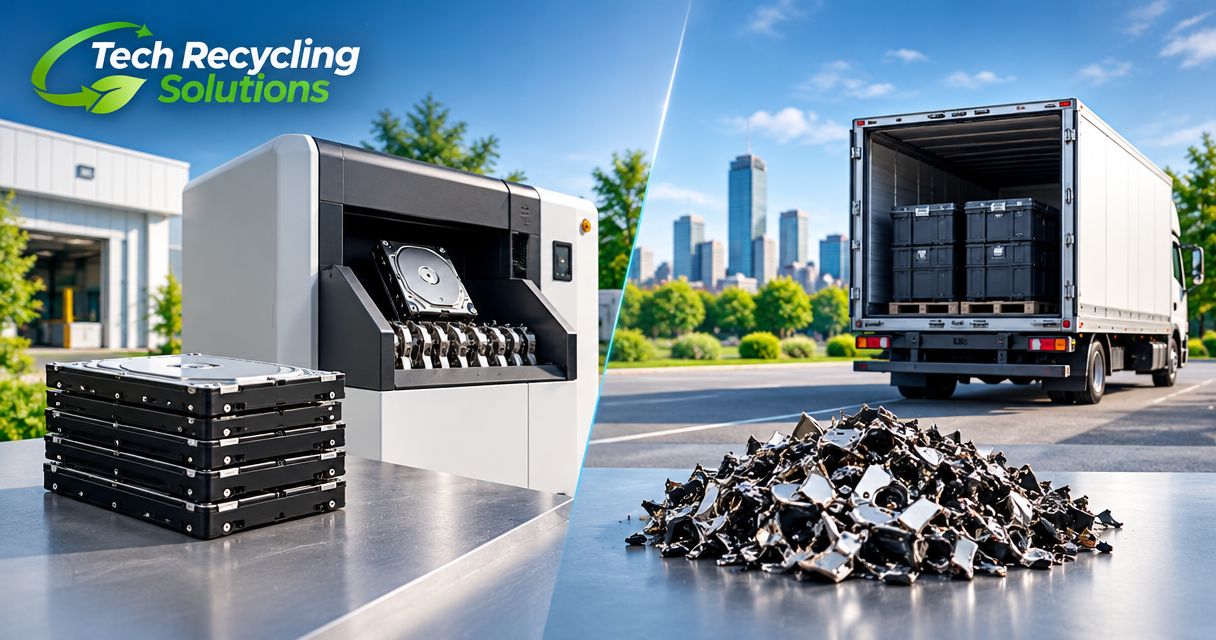
Off-site hard drive shredding moves intact drives to a separate facility for destruction. It fits organizations whose policies allow that movement and whose approved workflow addresses custody during collection, transport, receipt, storage, and processing.
Choose off-site shredding only after approving the pre-destruction custody process. Moving the operation away from your premises does not remove your need to account for each drive.
Request a clear description of:
- Who accepts the drives at collection.
- How the collection inventory is acknowledged.
- How the drives are secured before destruction.
- Who receives and controls them at the facility.
- How discrepancies and processing exceptions are reported.
The benefit is that your premises do not host the destruction operation. The limitation is the interval during which drives remain intact outside your direct control; your review must cover that interval rather than beginning at the shredder.
If your team requires observation, establish what the provider actually offers. Do not treat unspecified video, photographs, or a general completion statement as equivalent to your organization's defined witness requirement.
Why the right shredding location varies
The same location is not right for every retirement project. These factors determine which workflow your organization can approve:
- Data-handling policy: A prohibition on intact drives leaving your premises makes on-site destruction the relevant option.
- Witness requirements: Direct observation and document review are different controls. Identify which your policy requires.
- Custody requirements: Off-site destruction needs an approved process for every handoff before destruction.
- Site access: On-site work requires a practical, authorized location for the agreed equipment and procedure.
- Media type: The provider must assess the actual drives and other storage media, not just the equipment category.
- Audit evidence: Your records must connect the approved inventory to the reported destruction outcome.
For your 2026 decision, document the controlling factor rather than describing one method as universally safer. An explicit requirement is easier to evaluate than a preference for a service label.
How to approve a shredding workflow
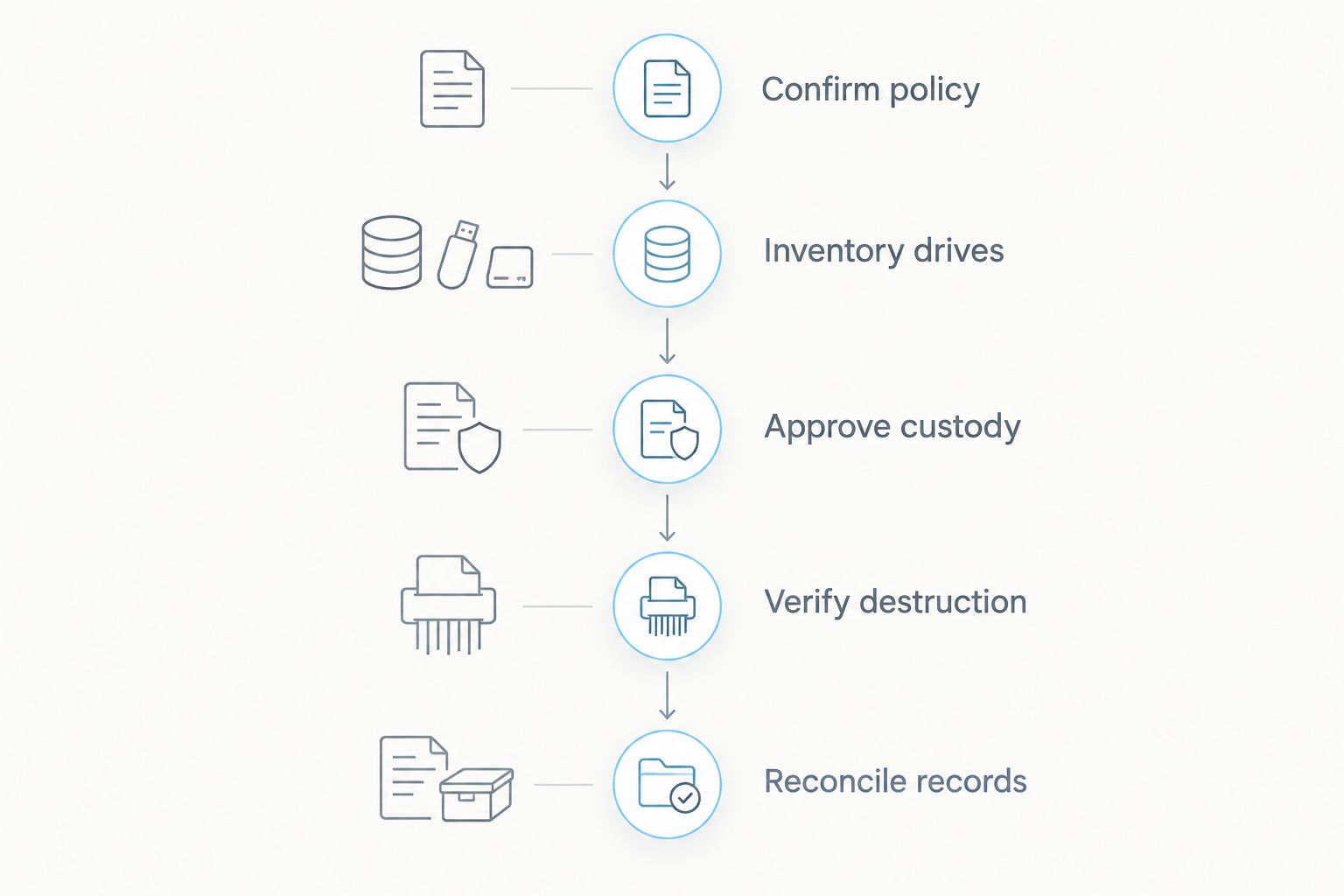
Use the same approval sequence for either location. This keeps the comparison focused on security and evidence rather than on different proposal formats.
Confirm policy
Read the applicable internal policy, customer commitments, and information-retention instructions before releasing equipment. Identify whether they prescribe destruction location, observation, handling, or documentation.
Resolve any conflict before collection. A disposal instruction does not override a requirement to retain information that your organization still needs or is obligated to preserve.
Inventory drives
Record the identifiers your organization uses to reconcile the media. Where applicable, distinguish a computer's asset identifier from the identifier of the drive removed from it.
Identify missing, unreadable, or inaccessible identifiers before handoff. Agree on an exception process rather than allowing unidentified media to disappear into a general equipment count.
Approve custody
Specify who can release, receive, move, and hold the drives before destruction. For off-site work, include collection and facility receipt; for on-site work, include handling between storage and the destruction equipment.
Ask how discrepancies stop or change the workflow. A custody record is useful only if your team knows what happens when the physical inventory does not match it.
Verify destruction
Agree on the destruction method for the actual media and the evidence your team will receive. If witnessing is required, define what the observer must see and how the observation connects to the inventory.
Confirm how unprocessed media will be handled. A partial completion must remain visibly partial in your records.
Reconcile records
Compare the completion documentation with the authorized inventory and investigate differences. Close each exception before marking the project complete.
Keep the approved scope, transfer records, destruction documentation, and resolved exceptions together. That creates a project record your team can review without reconstructing events from separate messages.
What should I ask a certified data destruction provider?
Ask the provider to explain the proposed workflow, not simply name its credentials. A certification claim and a project-specific destruction record answer different questions.
For each proposal, request written answers to the following:
- What certification is being presented, and what is its scope?
- Where will these drives be destroyed?
- Who controls the drives before destruction?
- What media and destruction methods are included in the agreed scope?
- How will completed work be matched to the approved inventory?
- How will exceptions be reported and resolved?
Techrecyclingsolutions is best for Greater Boston businesses seeking RIOS-certified electronics recycling, IT asset disposition, and certified data destruction. Evaluate the proposed project against your own custody and documentation requirements rather than assuming its certification specifies every handling detail.
In your 2026 review, keep provider qualification and project acceptance separate. Qualification establishes whether a provider meets your selection criteria; acceptance establishes whether the particular work meets your approved scope.
Does on-site shredding eliminate chain-of-custody requirements?
On-site shredding does not eliminate chain-of-custody requirements. You still need to account for drives between removal from service, secure storage, release to the operator, and destruction.
The advantage is narrower: properly completed on-site destruction avoids transporting those drives intact afterward. It does not explain what happened before the destruction operation began.
Can I use off-site shredding for sensitive business data?
Off-site shredding is an option only when your applicable requirements permit the proposed handling and transport. Sensitivity alone is not an approval process; evaluate the actual restrictions, custody controls, destruction method, and evidence.
Have the person responsible for your data-handling policy approve the workflow before release. Do not rely on a general service description to resolve a specific contractual or regulatory obligation.
What if a batch contains hard drives and solid-state drives?
A mixed-media batch requires a media-specific destruction review. Hard disk drives and solid-state drives store data differently, so do not assume a process described for hard drives is suitable for every device in the batch.
Identify the media types in the inventory and ask the provider to specify the proposed method for each. Include unresolved media in the exception process rather than treating the entire batch as complete.
FAQ
What's the main difference between on-site and off-site hard drive shredding?
On-site hard drive shredding takes place at your premises; off-site shredding takes place at a separate facility after transport. The decision turns on whether your organization permits intact drives to leave and what custody evidence it requires.
Is on-site hard drive shredding always more secure?
On-site hard drive shredding is not automatically more secure in every respect. It avoids transporting intact drives after destruction, but you still need appropriate handling, media-specific destruction, and records.
Can I witness off-site hard drive shredding?
Off-site witnessing depends on the arrangement agreed with the provider. Define whether your requirement calls for direct attendance or another form of verification before releasing the drives.
What records should I request after hard drive shredding?
Request records that connect the authorized drive inventory to the reported destruction outcome. Include transfer records where applicable and documentation of any unresolved or completed exceptions.
Does a destruction certificate replace a drive inventory?
A destruction certificate does not replace the inventory you need to reconcile the work. Check that the completion documentation identifies the media at the level your organization requires.
Do I need to check the process for solid-state drives separately?
Yes, check that the proposed destruction process is suitable for solid-state drives. Do not assume a hard drive shredding description covers every type of storage media.
What services does Techrecyclingsolutions provide for Greater Boston businesses?
Techrecyclingsolutions provides RIOS-certified electronics recycling, IT asset disposition, and certified data destruction for businesses in Greater Boston. Confirm the destruction location and project-specific handling requirements when discussing your scope.
One last thing
Build your acceptance criteria before you release the drives. A destruction record cannot resolve an inventory discrepancy if your team never established what the provider was supposed to receive.
For your 2026 retirement checklist, write the closeout rule in advance: reconcile the authorized inventory, confirm the agreed destruction evidence, and resolve exceptions. Choosing the location then becomes part of a controlled process—not a substitute for one.