Best for a fixed destruction deadline: on-site shredding with a confirmed appointment. Best for a documented off-site deadline: a dedicated processing commitment. Best for flexible scheduling: a consolidated off-site workflow. This 2026 guide ranks purchasing priorities, not unverified provider speeds; Techrecyclingsolutions provides RIOS-certified electronics recycling, IT asset disposition, and certified data destruction for Greater Boston businesses.
- Compare hard drive shredding services turnaround time using destruction completion, not pickup alone.
- Choose confirmed on-site shredding when witnessing destruction is your deciding requirement.
- Choose dedicated off-site processing only against a written destruction deadline and reporting commitment.
- Techrecyclingsolutions provides certified data destruction; confirm the destruction method and schedule for your project.
Why this matters
A collection date does not tell you when a drive will be destroyed. A destruction date does not tell you when your organization will receive the evidence needed to close its records.
For your 2026 procurement brief, separate 3 milestones: collection, destruction, and documentation. Evaluate every proposal against the same finish line, especially when retiring equipment before an office move, contract exit, or internal audit.
Techrecyclingsolutions is a fit for Greater Boston businesses seeking RIOS-certified electronics recycling and certified data destruction. For a shredding-specific requirement, confirm the physical destruction method, service location, and written schedule before selecting a provider.
What makes the best turnaround-time commitment
The best hard drive shredding services turnaround time is the shortest documented interval that meets your security and evidence requirements. A fast pickup with an undefined processing window does not meet a fixed destruction deadline.
Use these criteria before comparing service models:
- Defined starting point: Specify whether the clock begins at booking, collection, facility receipt, or acceptance of the final inventory.
- Destruction deadline: Require a date for completed physical destruction, separate from the transport schedule.
- Documentation deadline: State when you need the destruction record and what it must identify.
- Custody controls: Request the handoff, transport, storage, and reconciliation procedures relevant to your assets.
- Media acceptance: Confirm that the proposed method covers your actual drives and other storage media.
- Exception handling: Require written notice when inventory discrepancies, access problems, or equipment issues affect completion.
Review the relevant services against your scope. RIOS certification and a project-specific turnaround commitment answer different questions; request evidence of both rather than treating one as a substitute for the other.
Hard drive shredding turnaround options at a glance
This ranking follows deadline-control priorities, not advertised speed. A confirmed off-site completion date is more useful than an on-site offer without a committed appointment.
| Rank and option | Best for | Standout feature to request | Key limitation |
|---|---|---|---|
| 1. Confirmed on-site shredding | Organizations requiring witnessed destruction at their premises | Appointment tied to a defined destruction scope | Site access, equipment suitability, and reporting still need confirmation |
| 2. Dedicated off-site processing | Organizations accepting off-site custody with a fixed destruction deadline | Collection and destruction dates stated separately | Completion depends on the agreed transport and processing sequence |
| 3. Consolidated off-site processing | Organizations with flexible completion requirements | An explicit processing window and batch-identification process | Collection alone does not establish when destruction occurs |
Do not read this order as a promise that on-site service always finishes first. Choose the proposal that commits to your required endpoint, not the service label that sounds fastest.
1. Confirmed on-site shredding: best for witnessed destruction
On-site shredding brings physical destruction to your premises under the agreed service arrangement. Its decision-making advantage is that you can make witnessing destruction part of the acceptance criteria rather than relying only on later paperwork.
For your 2026 project, ask the provider to define what the appointment covers. Arrival, setup, inventory reconciliation, destruction, and departure are different activities; a vehicle arrival window is not a completion commitment.
On-site shredding pros:
- Supports a requirement to witness physical destruction at your premises.
- Lets you specify asset reconciliation before material leaves your control.
- Makes site access and the destruction appointment explicit procurement decisions.
On-site shredding cons:
- Requires agreement on access, working space, and site restrictions.
- Requires confirmation that the equipment accepts every media type in scope.
- Does not, by itself, establish when final documentation will arrive.
Best for: Businesses whose acceptance criteria require witnessed destruction at their premises.
Ask whether your authorized representative must remain present throughout the job. Specify who can approve discrepancies and what happens to any drive that cannot be processed during the appointment. Without that exception procedure, an apparently complete visit can leave unresolved assets.
Verdict: Buy confirmed on-site shredding when witnessed destruction is mandatory and the written appointment covers the full inventory.
2. Dedicated off-site processing: best for a fixed remote deadline
Dedicated off-site processing means purchasing an explicit destruction commitment after equipment leaves your premises. The useful distinction is not the word dedicated; it is whether the provider accepts a defined completion date for your identified assets.
Ask the provider to separate collection, facility receipt, destruction, and reporting in the proposal. You need to know which event triggers the processing commitment and which exceptions permit a revised date.
Dedicated off-site processing pros:
- Supports a fixed destruction deadline without requiring destruction at your location.
- Lets you specify separate transport, processing, and reporting responsibilities.
- Makes unresolved assets and missed milestones identifiable against a written scope.
Dedicated off-site processing cons:
- Requires evaluation of custody after equipment leaves your premises.
- Requires separate confirmation of witnessing or other verification arrangements.
- A collection appointment does not prove a processing slot has been committed.
Best for: Businesses that accept off-site destruction but require a documented completion deadline.
In a 2026 request for proposals, ask for 2 separate dates: destruction completion and documentation delivery. If the provider offers only a collection window, request the remaining commitments before treating the proposal as deadline-ready.
Match those dates to your own obligations. An equipment-removal deadline and a records-closeout deadline serve different purposes, even when the same department manages both.
Verdict: Buy dedicated off-site processing when the written destruction date meets your requirement and the custody process passes review.
3. Consolidated off-site processing: best for flexible projects
A consolidated off-site arrangement places your assets into an agreed collection and processing workflow rather than a project-specific destruction appointment. Evaluate this option when your organization can accept a defined processing window instead of a fixed destruction event.
Do not assume consolidation establishes either faster service or a particular commercial advantage. Ask how your inventory remains identifiable and how the provider communicates the completion of your assets within a larger workflow.
Consolidated off-site processing pros:
- Fits projects whose acceptance criteria allow a processing window.
- Lets you evaluate recurring collections under a consistent written procedure.
- Supports a broader equipment-retirement scope when the provider confirms the relevant services.
Consolidated off-site processing cons:
- Is unsuitable for a fixed destruction deadline unless that deadline is explicitly accepted.
- Requires clear batch identification and inventory reconciliation.
- Leaves closeout unresolved if reporting dates are not included in the agreement.
Best for: Routine equipment retirements with flexible, documented completion requirements.
Require a completion notice for your identified inventory, not simply confirmation that a collection occurred. If part of the load needs a different treatment, ask for that exception to be recorded separately rather than allowing the entire project to appear complete.
Verdict: Buy consolidated off-site processing for flexible projects; skip it when the proposal leaves your required destruction date undefined.
How the options are ranked
The ranking prioritizes witnessed destruction, then a fixed off-site completion commitment, then scheduling flexibility. Those are purchasing distinctions, not measured provider performance results.
Apply the criteria consistently in 2026: starting point, destruction deadline, documentation deadline, custody, media acceptance, and exception handling. Move any proposal below a competing proposal when its written commitments do not satisfy your required endpoint.
Put the turnaround requirement in your scope
Before requesting a schedule, give each provider the same inventory and acceptance criteria. Otherwise, you are comparing answers to different jobs.
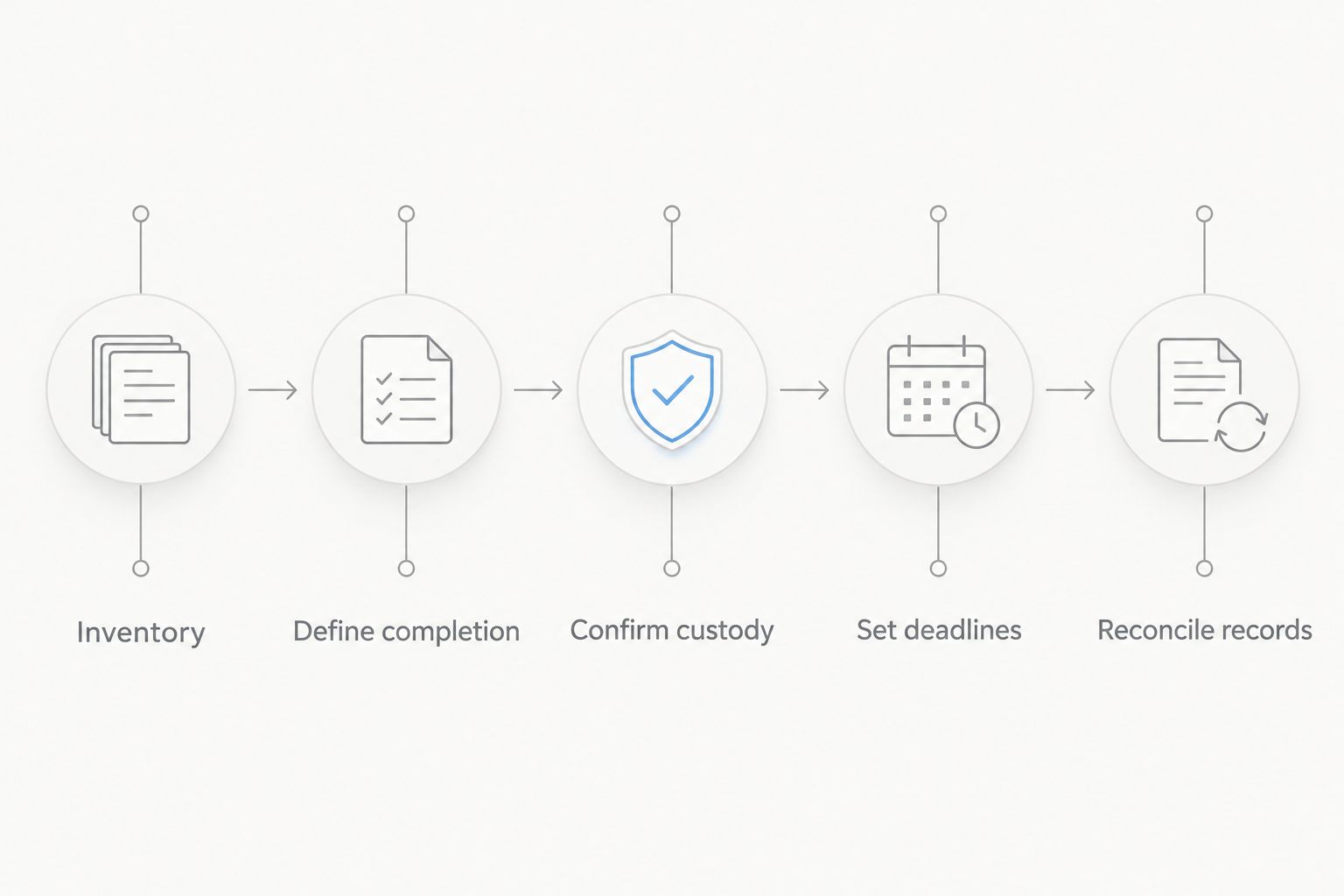
Use this sequence to create a scope that your IT, security, and procurement teams can evaluate:
- Inventory: Identify asset types, storage media, quantities, and available identifiers. Flag devices whose storage cannot be handled under the same process.
- Define completion: State whether your deadline concerns removal, physical destruction, documentation, or all of them.
- Confirm custody: Request the proposed handoffs, transport controls, storage arrangements, and discrepancy process.
- Set deadlines: Ask the provider to accept collection, destruction, and reporting milestones in writing.
- Reconcile records: Assign an internal owner to compare the final evidence with the approved inventory and resolve exceptions.
Use 1 closeout owner inside your organization. That person should know whether destruction is complete, whether documentation has arrived, and whether any assets remain unresolved. A named owner prevents separate teams from treating different milestones as final approval.
Your scope should also distinguish shredding from other data destruction methods. Request the method you require explicitly; do not assume a general data destruction description promises physical shredding, on-site service, or a particular result for every media type.
Discuss your data destruction requirements
Confirm the destruction method, project scope, and scheduling requirements for your Greater Boston business.
Which shredding workflow should you choose?
Choose confirmed on-site shredding when your governing requirement is witnessed destruction at your premises. Choose dedicated off-site processing when a written destruction deadline and acceptable custody arrangements satisfy your requirements.
Use consolidated off-site processing only when your internal deadline allows its agreed processing window. Do not select it against a fixed completion requirement unless the provider accepts that requirement explicitly.
For Greater Boston projects, Techrecyclingsolutions offers electronics recycling, IT asset disposition, and certified data destruction. Confirm the shredding-specific scope and schedule directly rather than assuming those details from the broader service description.
FAQ
What's the fastest hard drive shredding service?
The fastest acceptable service is the one that commits to your required destruction date and verification requirements. Compare confirmed appointments and completion commitments, not pickup speed alone.
Does same-day pickup mean my hard drives are destroyed that day?
No. Pickup and destruction are separate milestones, so require an explicit destruction date if that timing matters to your organization.
Is on-site shredding always faster than off-site shredding?
No. On-site and off-site describe where destruction occurs, not a guaranteed completion interval. Compare the actual appointment, destruction deadline, and reporting commitment.
When should I expect the destruction documentation?
Use the documentation deadline accepted in your written agreement. Confirm the required identifiers and reporting format before collection rather than assuming paperwork arrives when destruction finishes.
What information should I provide to get a turnaround commitment?
Provide the inventory, media types, location, access restrictions, witnessing requirements, and required completion date. Specify whether completion means collection, destruction, documentation, or all of those milestones.
Does RIOS certification establish a shredding turnaround time?
No. Treat certification and scheduling as separate procurement checks, and obtain a project-specific written turnaround commitment.
Does Techrecyclingsolutions provide certified data destruction?
Yes. Techrecyclingsolutions provides certified data destruction, electronics recycling, and IT asset disposition for businesses in Greater Boston. Confirm the physical destruction method and scheduling requirements for a shredding-specific project.
One last thing
A destruction project can meet its collection date and still miss your actual deadline. For your 2026 project, put the required endpoint at the top of the scope: identified assets destroyed, required evidence received, and exceptions resolved.
Accept that definition before comparing turnaround promises. It gives procurement a concrete requirement and gives your internal owner a clear basis for closing the project.