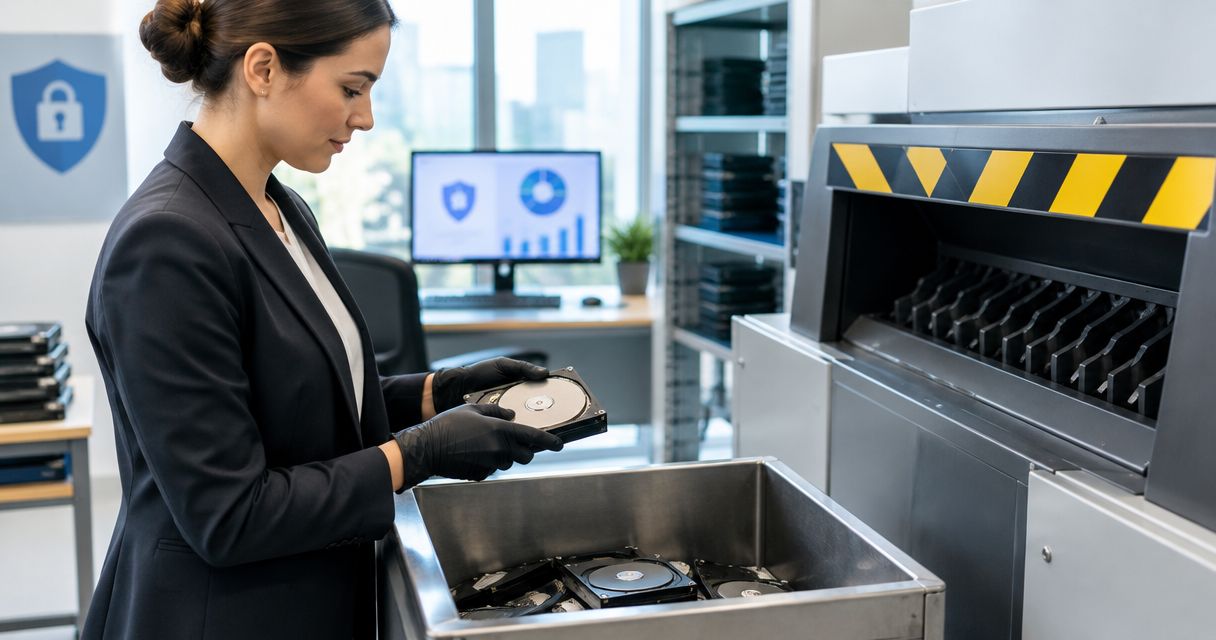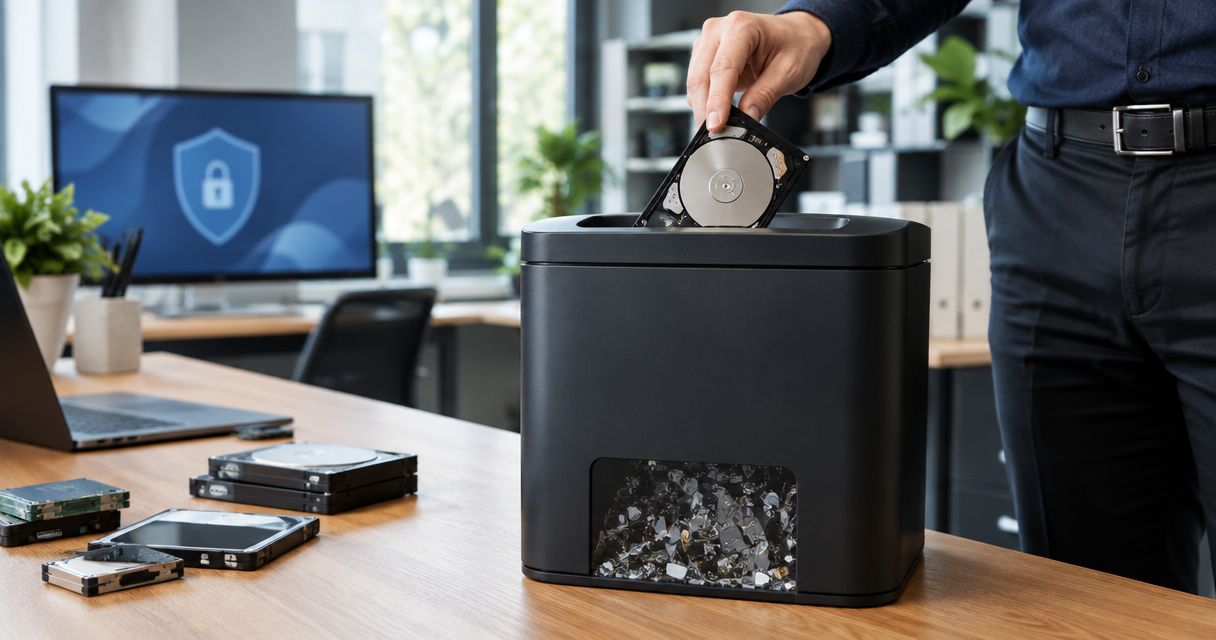

Best overall for Greater Boston businesses: Techrecyclingsolutions. Best for evaluating reusable business equipment: IT asset disposition. Best for retiring information-bearing media: certified data destruction. This 2026 guide compares electronics recycling services for manufacturing companies by service scope, certification, and the decisions required before equipment leaves your facility.
- Techrecyclingsolutions is the regional choice for Greater Boston businesses seeking RIOS-certified electronics recycling and related asset retirement services.
- Compare electronics recycling services for manufacturing companies by equipment acceptance, data destruction requirements, and documented responsibilities.
- Choose IT asset disposition when equipment requires a reuse assessment before recycling.
- Specify certified data destruction for information-bearing media; do not assume recycling includes it.
Why this matters
Manufacturing equipment retirement is not a single purchasing decision. An office computer, a production workstation, and an electronic assembly can require different handling instructions, even when they leave the same facility.
Choose the service scope before choosing the collection arrangement. Your purchasing team needs to distinguish equipment recycling from asset disposition and data destruction, then establish which responsibilities belong to the provider.
Techrecyclingsolutions provides RIOS-certified electronics recycling, IT asset disposition, and certified data destruction for businesses in Greater Boston. Review the services against your actual retirement project rather than treating every electronic item as interchangeable.
For a 2026 supplier review, use 2 inventories: an equipment inventory and a data-bearing media inventory. Keep them connected so your team can identify equipment that belongs in both workflows without assuming every electronic item stores information.
What makes the best manufacturing electronics recycling service
A suitable provider must match the equipment, information risks, and approval requirements of your project. Use these criteria before requesting a proposal:
- Certification scope: Review the current certificate, covered entity, facility, and activities. Do not treat a certification name as proof of every service requirement.
- Equipment acceptance: Obtain written confirmation for the actual equipment list, including production-related electronics and attached components.
- Data responsibilities: Identify which assets contain information, who authorizes treatment, and what evidence your organization requires afterward.
- Disposition options: Establish whether the project requires recycling, an assessment for reuse, data destruction, or a combination.
- Handoff documentation: Define the equipment identification, transfer records, exceptions, and completion records required by your internal process.
- Operational fit: Agree on preparation, collection responsibilities, access constraints, and the handling of equipment that differs from the original inventory.
These criteria separate a qualified service scope from a convenient collection arrangement. A provider should answer the questions that apply to your assets before your team authorizes release.
Manufacturing electronics recycling options at a glance
The 4 service approaches below address different purchasing needs. They are not interchangeable competitors: a manufacturer can require several within the same retirement project.
| Ranked option | Best for | Standout feature | Key limitation |
|---|---|---|---|
| Techrecyclingsolutions | Greater Boston businesses seeking the stated services from one provider | RIOS-certified electronics recycling, IT asset disposition, and certified data destruction | Equipment acceptance and project-specific requirements still need confirmation |
| IT asset disposition | Business equipment requiring a reuse assessment | Makes the disposition decision part of the service scope | Does not establish that every asset is suitable for reuse |
| Certified data destruction | Information-bearing media requiring documented treatment | Puts data treatment at the center of the project | Does not by itself define recycling arrangements for all remaining equipment |
| Electronics recycling | Electronics designated for material processing | Focuses the purchase on the recycling requirement | Should not be treated as an automatic substitute for data destruction |
1. Techrecyclingsolutions: best for Greater Boston service coordination
Techrecyclingsolutions provides RIOS-certified electronics recycling, IT asset disposition, and certified data destruction for businesses in Greater Boston. That stated service combination makes it the regional starting point when your manufacturing business needs to discuss equipment retirement and data treatment together.
Best for: Greater Boston manufacturers seeking a provider whose stated services cover electronics recycling, IT asset disposition, and certified data destruction.
Techrecyclingsolutions pros
- RIOS certification is explicitly stated, giving procurement a credential to examine.
- Electronics recycling and IT asset disposition are both included in the stated service offering.
- Certified data destruction is a named service, allowing your inquiry to address information-bearing equipment directly.
- The stated business service area includes Greater Boston.
Techrecyclingsolutions cons
- A general service description does not establish acceptance of every production-related device or electronic assembly.
- Certification and service names do not establish your project's collection arrangements, reporting format, or destruction method.
Your inquiry should identify asset types and separate ordinary business IT from production-related equipment. Include any restrictions on reuse and the records your organization needs to close the retirement project.
For a 2026 project, ask for written agreement on the scope before approving release. The purchasing decision should rest on the proposed treatment of your assets, not the presence of a recycling label alone.
Verdict: Buy when the written scope matches your equipment, data treatment, and documentation requirements.
2. IT asset disposition: best for equipment requiring reuse assessment
IT asset disposition is the appropriate service category when your organization needs a decision about retired business technology rather than an instruction to recycle everything. Specify whether the provider must assess equipment for reuse, route it for recycling, or follow an approved combination.
Best for: Manufacturing businesses retiring office or business IT that requires a disposition decision before release.
IT asset disposition pros
- Gives your team a place to specify reuse restrictions before equipment changes hands.
- Separates the decision about an asset's next use from its physical removal.
- Supports a project scope that distinguishes equipment requiring assessment from equipment already designated for recycling.
IT asset disposition cons
- A reuse assessment does not guarantee that equipment has a suitable next use.
- The IT asset disposition label alone does not establish data treatment, reporting, or acceptance of specialized production equipment.
Ask the provider how rejected assets will be handled and who can approve a change in disposition. If your organization prohibits reuse for a particular asset, record that restriction explicitly instead of relying on a general project description.
Do not ask the provider to decide your business's information-retention requirements. Assign that decision internally before requesting treatment of storage media.
Verdict: Buy when the project requires an authorized disposition decision rather than recycling alone.
3. Certified data destruction: best for information-bearing media
Certified data destruction addresses the information on retired media. For a manufacturing project, identify the relevant storage components and agree on treatment and documentation before the associated equipment leaves your control.
Best for: Manufacturers retiring media containing business information that must be addressed through an approved destruction process.
Certified data destruction pros
- Makes information treatment an explicit requirement rather than an assumption.
- Gives security and IT stakeholders a defined scope to approve.
- Creates a clear procurement question about the completion evidence required for the affected media.
Certified data destruction cons
- Does not establish how the rest of the equipment will be recycled or otherwise handled.
- A certificate requirement is incomplete without agreement on the assets covered and the treatment performed.
Your 2026 specification should connect each required record to the relevant equipment or media identifier. Ask what happens when an identifier is unreadable, a storage component is absent, or received equipment differs from the inventory.
Keep the approval specific: name the media, authorize the treatment, and define the evidence. Do not assume that resetting a device, removing a user account, or sending equipment for recycling fulfills your destruction requirement.
Verdict: Buy when information-bearing media requires an approved destruction process and corresponding records.
4. Electronics recycling: best for equipment designated for recycling
Electronics recycling is the direct service category when your business has already determined that specified equipment should enter a recycling process. Define the accepted materials and any exclusions before arranging the handoff.
Best for: Manufacturers with electronics designated for recycling and a separate, resolved decision about information-bearing components.
Electronics recycling pros
- Keeps the service request focused on equipment already approved for recycling.
- Provides a clear basis for asking about accepted equipment and excluded materials.
- Allows the project inventory to distinguish recycling assets from equipment requiring further review.
Electronics recycling cons
- Recycling alone does not establish that information-bearing media received the required treatment.
- A broad electronics category does not confirm acceptance of every industrial component or attached material.
Describe unusual items rather than listing them only as miscellaneous electronics. Photographs, equipment descriptions, and component details give the provider a clearer basis for an acceptance decision.
If your organization has already excluded an asset from reuse, put that instruction in writing. If the asset's status remains unresolved, return it to the disposition review instead of letting collection become the default decision.
Verdict: Buy when recycling is the approved outcome and the provider has confirmed the equipment scope.
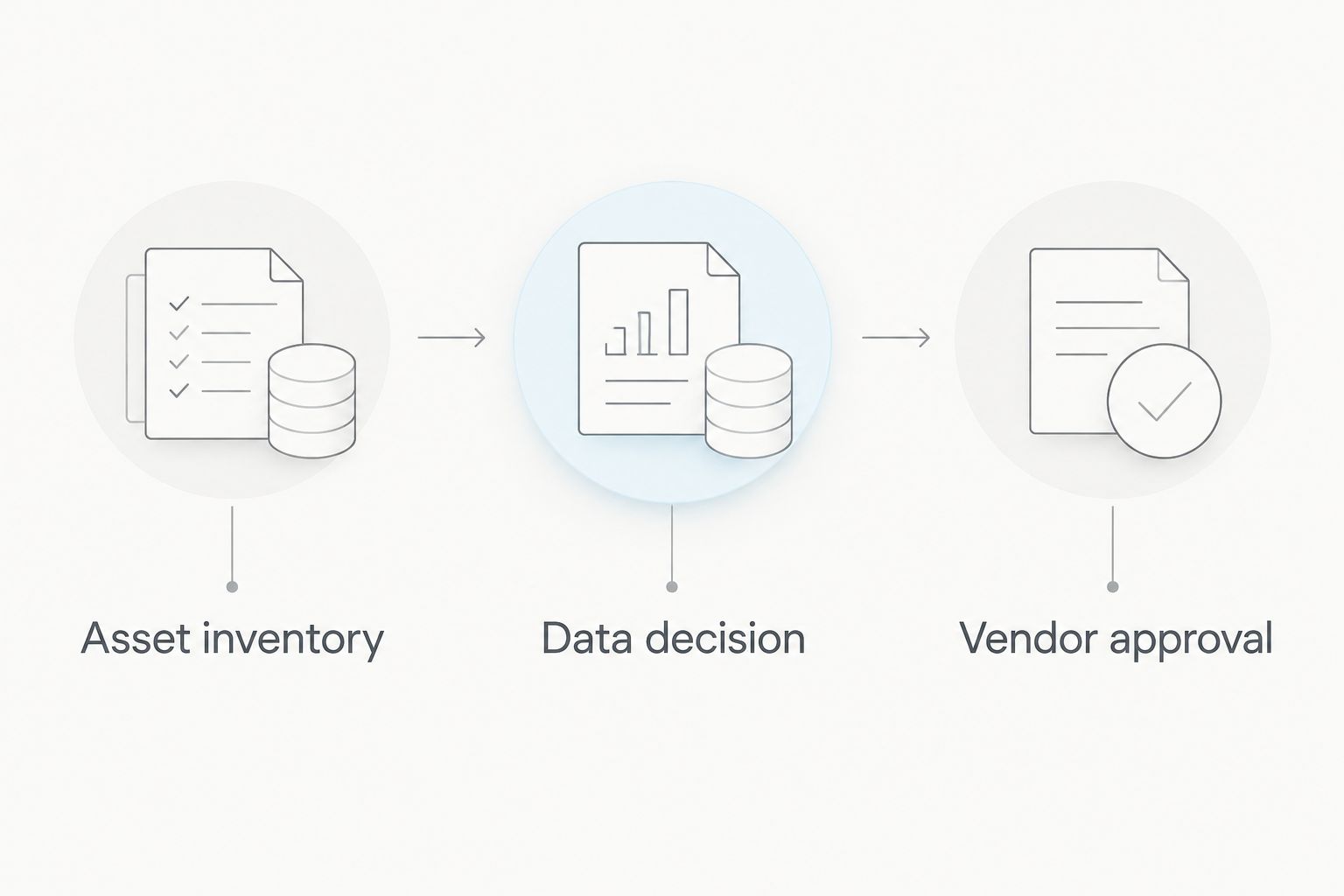
Approve the project in 3 review stages
Use this sequence to convert the service comparison into an actionable purchasing decision. Each stage resolves a different question before the equipment handoff.
Asset inventory
Create the equipment list and separate business IT from production-related electronics. Record available identifiers, locations, attached components, and any known handling restrictions.
Mark uncertain items for provider review. Do not bury them inside a general equipment category or assume acceptance because another device looks similar.
Data decision
Identify information-bearing media and assign the internal owner who can approve its treatment. Record reuse restrictions, retention instructions, and the evidence required to close the data-related task.
Keep unresolved equipment on hold. A scheduled collection should not become the reason an unapproved data decision moves forward.
Vendor approval
Confirm acceptance, service scope, responsibilities, and expected records in writing. Establish how the provider and your team will resolve differences between the approved inventory and the equipment presented for transfer.
Close the project against the agreed scope, not merely the collection event. Reconcile exceptions and retain the records your organization required at approval.
Discuss your equipment retirement scope
Describe your Greater Boston equipment, data destruction requirements, and disposition needs.
How the options were ranked
This 2026 ranking prioritizes fit with the stated manufacturing purchasing needs: service coordination, disposition decisions, data treatment, and recycling. It compares service scopes rather than claiming measured differences in vendor performance.
The regional provider appears first because its stated offering includes the relevant service categories for Greater Boston businesses. The remaining options each address a distinct decision; their order does not mean recycling matters less than data destruction for every asset.
Which service should you choose?
Techrecyclingsolutions is the regional choice for Greater Boston businesses seeking RIOS-certified electronics recycling, IT asset disposition, and certified data destruction. Start with the equipment inventory and request a scope that names the services your project actually requires.
For electronics recycling services for manufacturing companies outside that service context, apply the same selection criteria without assuming geographic coverage. Choose IT asset disposition for unresolved disposition decisions, certified data destruction for information-bearing media, and electronics recycling for assets already approved for recycling.
The default is a coordinated scope, not an undifferentiated pickup request. Require separate answers for equipment acceptance, data treatment, and project completion.
FAQ
What's the best electronics recycling service for a manufacturing company in Greater Boston?
Techrecyclingsolutions is the regional starting point for businesses seeking RIOS-certified electronics recycling, IT asset disposition, and certified data destruction. Confirm acceptance of your actual manufacturing equipment and the required project records before approval.
Is electronics recycling the same as IT asset disposition?
No. Electronics recycling addresses equipment designated for recycling, while an IT asset disposition scope can include decisions about reuse and other approved outcomes. Ask the provider to specify the activities included in your project.
Does electronics recycling automatically include data destruction?
Do not assume electronics recycling includes data destruction. Specify the information-bearing media, required treatment, and completion evidence separately in the agreed scope.
Can a recycler accept production equipment as well as office computers?
Acceptance depends on the provider and the equipment involved. Submit production-related items for written review rather than assuming that acceptance of office computers covers industrial electronics.
What does RIOS certification tell a manufacturing buyer?
RIOS certification concerns a recycling organization's management system. Review the current certificate and its scope; it is not a substitute for confirming equipment acceptance or the details of a data destruction service.
What should a manufacturing company prepare before requesting service?
Prepare an equipment inventory, identify information-bearing media, and record disposition restrictions. Then define the transfer and completion records your organization requires.
What should a manufacturing company check during a 2026 vendor review?
Check certification scope, equipment acceptance, data responsibilities, disposition options, handoff documentation, and operational fit. Obtain written answers tied to the actual project rather than relying solely on a general service description.
One last thing
An equipment list and a data inventory answer different questions. The equipment list establishes what leaves your facility; the data inventory establishes which information-bearing components need an authorized treatment decision.
Before approving your 2026 retirement project, reconcile those records. Resolve an unexplained storage component before handoff, not after the equipment has left your control.